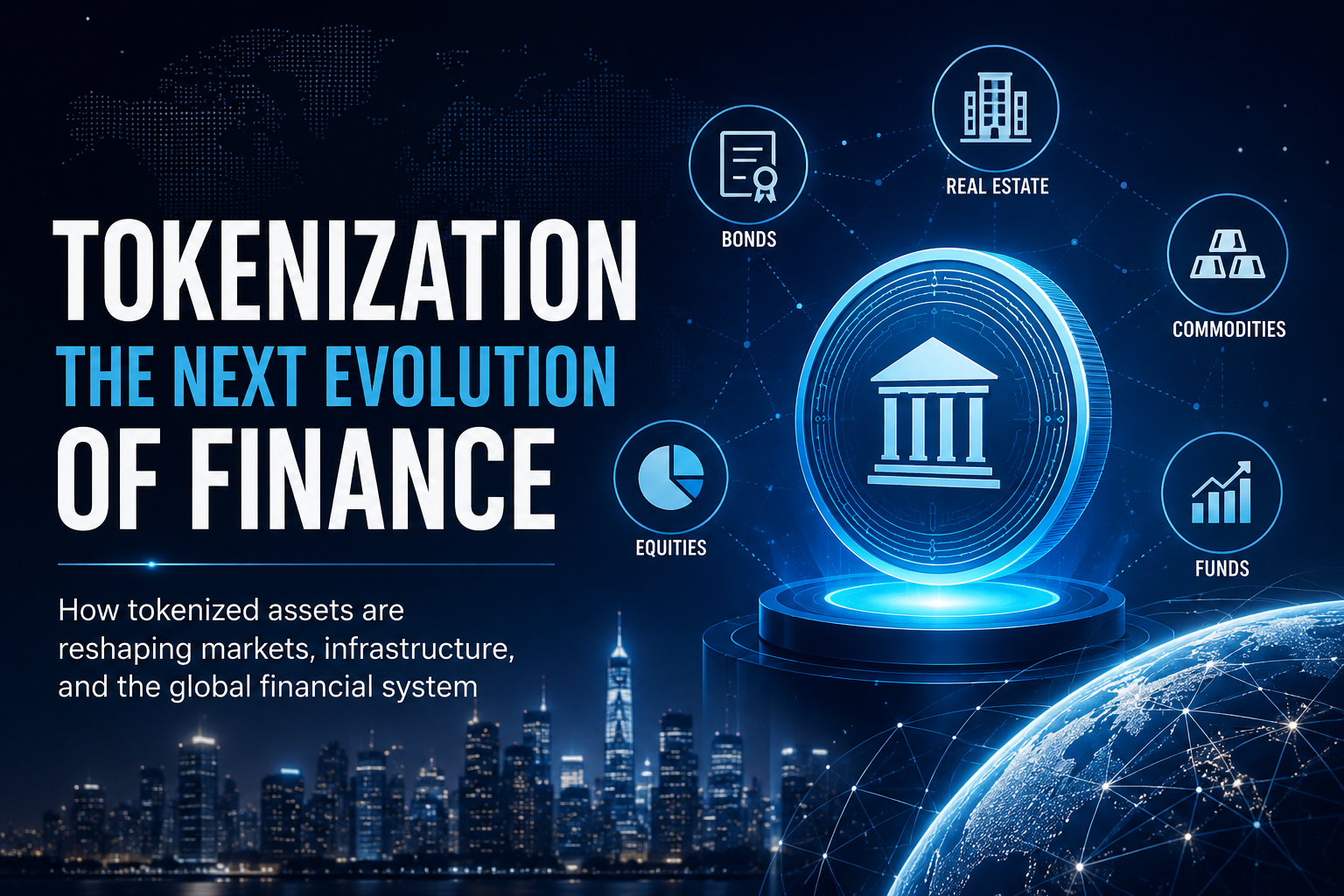
Why Tokenization Is Becoming One of the Most Important Topics in Finance
Over the last few years, the word tokenization has moved far beyond the cryptocurrency community. What was once considered a niche blockchain concept is now being discussed by global exchanges, investment banks, asset managers, regulators, and financial infrastructure providers around the world.
The reason is simple: tokenization is increasingly being viewed not as a speculative trend, but as a potential redesign of financial infrastructure itself.
When people hear the word tokenization, many still think about meme coins or volatile crypto assets. But institutional finance is approaching the concept from a very different angle. The real conversation today is about how financial assets, ownership rights, settlement systems, and capital markets could evolve in a more digital and programmable environment.
In many ways, tokenization is less about “crypto” and more about the future architecture of finance.
What Is Tokenization?
At its core, tokenization means representing an asset digitally on a blockchain or distributed ledger.
That asset could be:
a stock
a bond
real estate
a fund
gold
treasury securities
infrastructure assets
private credit
even intellectual property
Instead of ownership records being maintained entirely through traditional centralized databases and intermediaries, tokenized systems use programmable digital tokens to represent value and ownership.
This may sound highly technical at first, but the broader idea is actually quite intuitive.
Modern finance still relies on many fragmented systems:
custodians
clearing houses
settlement agents
transfer agents
multiple reconciliation layers
Tokenization attempts to streamline some of these processes by enabling assets to move through programmable digital infrastructure.
Why Financial Institutions Are Paying Attention
Large financial institutions are not exploring tokenization simply because blockchain became popular.
They are exploring it because existing market infrastructure still contains significant inefficiencies.
Cross-border transactions remain expensive and slow. Settlement processes often require multiple intermediaries. Private markets remain difficult to access. Operational reconciliation costs are still substantial.
Tokenization introduces the possibility of:
faster settlement
fractional ownership
programmable compliance
improved transparency
enhanced asset mobility
potentially lower operational friction
For institutions, this is fundamentally an infrastructure efficiency discussion.
That is why some of the world’s largest banks and exchanges are now actively experimenting with tokenized systems.
The Rise of Tokenized Real-World Assets
One of the most important trends in this space is the emergence of tokenized real-world assets, often called RWAs.
This area focuses on bringing traditional financial assets onto blockchain-based infrastructure.
Examples include:
tokenized treasury products
tokenized money market funds
tokenized private credit
tokenized real estate
tokenized commodities
This trend is particularly important because it bridges traditional finance and digital infrastructure.
Rather than creating entirely new speculative assets, institutions are exploring how existing financial products can become more programmable and globally accessible.
In many ways, this is where tokenization begins to feel much more practical and institutional.
Why Exchanges Care About Tokenization
Global exchanges are also paying close attention.
Exchanges sit at the center of financial markets:
trading
market data
listing services
settlement coordination
market surveillance
Tokenization has the potential to influence nearly all of these functions.
For example, tokenized systems may eventually enable:
24/7 trading environments
programmable settlement
new forms of digital asset listings
fractionalized ownership models
entirely new categories of market data
At the same time, exchanges must carefully balance innovation with stability and regulation.
Capital markets cannot simply abandon investor protection, surveillance, or governance frameworks in pursuit of technological novelty.
That is why most institutional tokenization initiatives today are highly controlled and permissioned rather than fully decentralized.
The Infrastructure Conversation Is More Important Than the Hype
One of the biggest misconceptions about tokenization is that it is only about cryptocurrency trading.
The more important story may actually be invisible to retail users.
Behind the scenes, financial institutions are increasingly asking questions such as:
How should settlement work in a programmable environment?
How should ownership records evolve?
Can collateral move more efficiently?
How can market infrastructure become more interoperable?
How should regulation adapt?
These are infrastructure-level questions.
In many ways, tokenization resembles earlier transitions in finance:
the rise of electronic trading
the shift from floor trading to digital exchanges
cloud computing adoption
API-based financial services
At first, these technologies appeared experimental. Eventually, they became foundational.
Tokenization may follow a similar path.
Stablecoins and Digital Cash
Another important aspect of tokenization is the growth of stablecoins and tokenized cash systems.
Stablecoins are essentially blockchain-based representations of fiat currencies.
Their significance goes far beyond crypto speculation.
Stablecoins may eventually influence:
cross-border payments
treasury operations
settlement systems
global liquidity flows
programmable commerce
At the same time, regulators remain cautious regarding:
reserve backing
systemic risk
operational resilience
monetary sovereignty
As a result, central banks are also exploring digital currency initiatives and tokenized settlement models.
The future financial system may ultimately contain multiple forms of tokenized money operating simultaneously.
AI and Tokenization May Converge
Another fascinating trend is the intersection between AI and tokenization.
As tokenized ecosystems grow, they generate enormous amounts of machine-readable financial data:
wallet flows
smart contract interactions
on-chain ownership movements
tokenized liquidity metrics
AI systems may eventually help institutions:
monitor market activity
automate compliance
analyze liquidity
detect abnormal behavior
optimize collateral management
generate investment intelligence
This creates the possibility of increasingly programmable and machine-operable financial systems.
The convergence of AI and tokenized infrastructure may become one of the defining themes of next-generation finance.
The Challenges Are Still Significant
Despite the excitement, tokenization still faces major obstacles.
Regulation remains fragmented globally. Technical interoperability is still immature. Security risks continue to exist. Legal recognition of digital ownership structures is evolving slowly.
There are also operational questions:
Should settlement always be instant?
How should disputes be handled?
What happens if smart contracts fail?
How should tokenized systems integrate with traditional finance?
These issues are complex and institutional in nature.
That is why tokenization adoption will likely happen gradually rather than through sudden disruption.
Final Thoughts
Tokenization is increasingly becoming one of the most important conversations in global finance not because it replaces traditional finance, but because it may gradually modernize parts of it.
The future is unlikely to be a world where traditional institutions disappear overnight.
Instead, we may see:
hybrid financial systems
programmable settlement infrastructure
tokenized asset layers
interoperable digital ownership systems
AI-enhanced market infrastructure
In that sense, tokenization is not just a technology trend.
It is an infrastructure evolution story.
And like many infrastructure transitions before it, its most important effects may emerge slowly, quietly, and structurally over time.